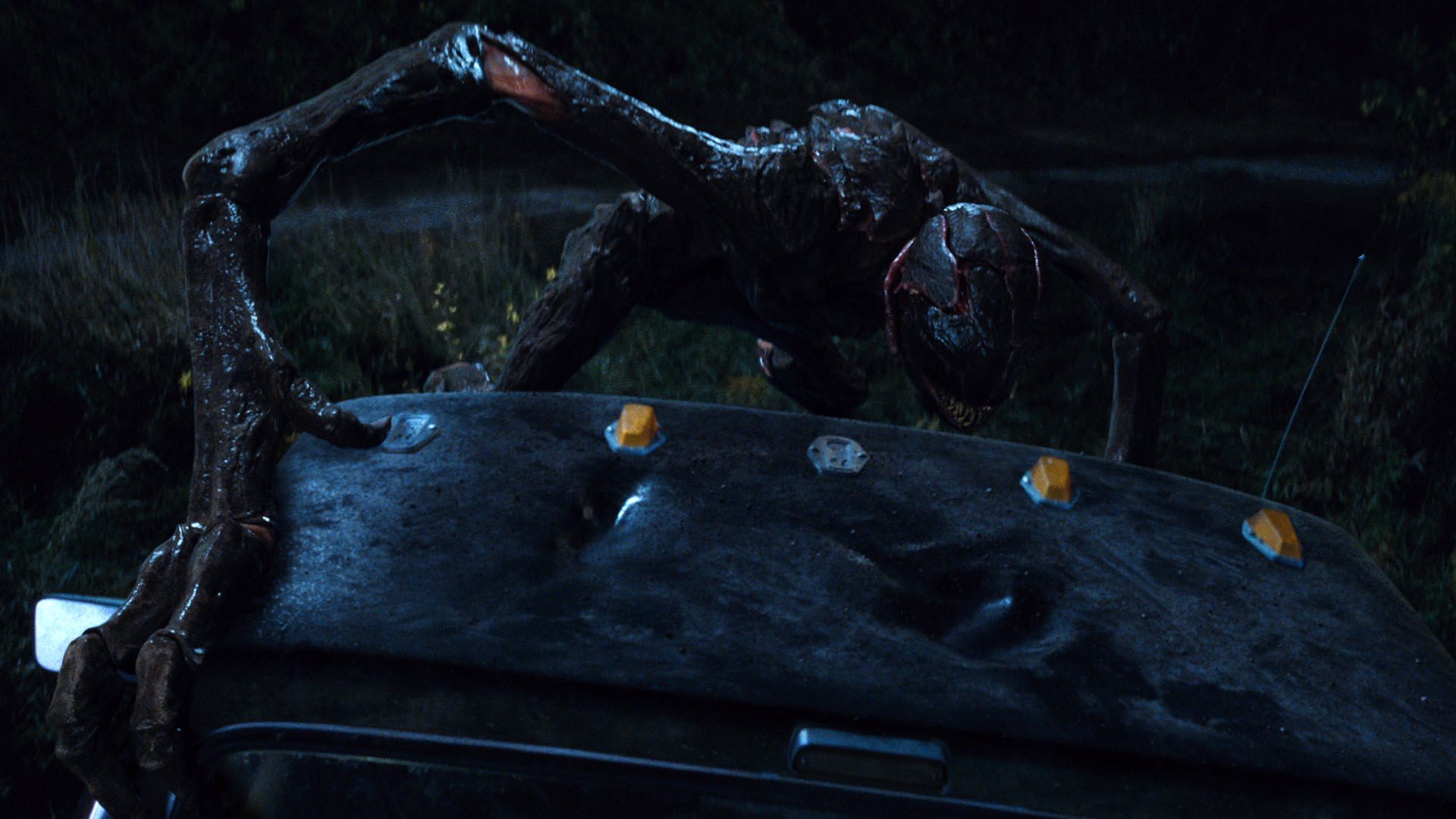
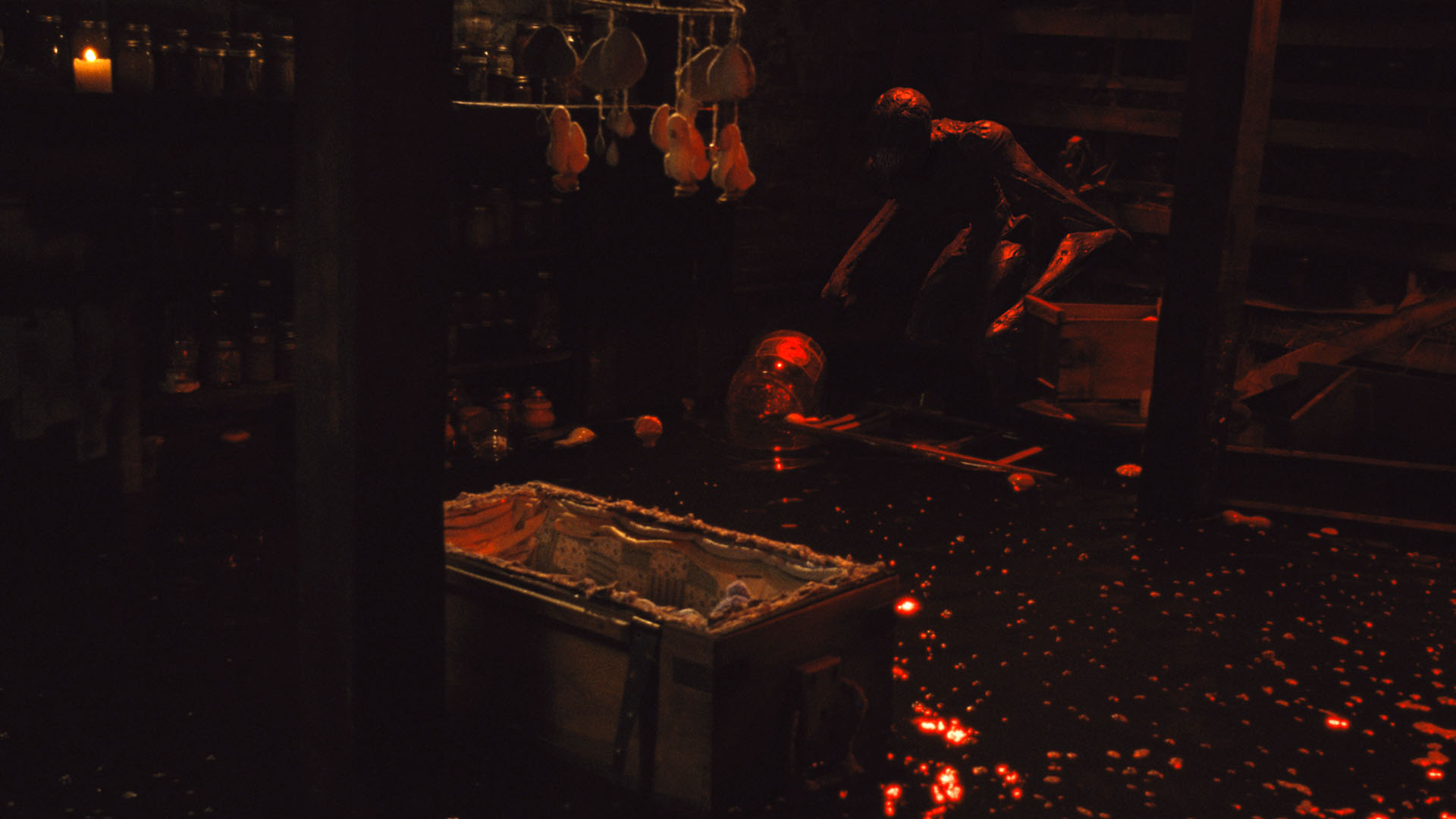
In the post-apocalyptic world that is the setting of A Quiet Place, a family is forced to live in silence while hiding from monsters with ultra-sensitive hearing. In addition to a variety of general effects work ranging from set extensions and paintouts, ILM was tasked with creating the monsters that are terrorizing what’s left of the human population on Earth.
Director John Krasinski had enlisted ILM to bring the blind, shrieking creatures to life but when the decision was made to push the design from merely scary to something truly terrifying with just one month left before release, it was the ILM team led by visual effects supervisor Scott Farrar and animation supervisors Scott Benza and Rick O’Connor who had to deliver that terror in record time.
In the end, collaborating with Krasinski ILM’s design team came up with the stuff of nightmares, a creature that makes the hair on the back of your neck stand up the moment you catch a glimpse of it on-screen. The reptilian-like humanoid creature was quadruped with a large head and a lobster-like exoskeleton. It had no eyes, horrific rows of sharp teeth, and claws that could rip a person’s limb clean off.
In the end, the revised design was a tremendous success and supported Krasinski’s vision amping up the fear factor and tension in every scene it played in.
The Mandalorian which debuted on Disney+ in November 2019 was set five years after the events depicted in Return of the Jedi. To achieve the vision of series creator Jon Favreau, Industrial Light & Magic worked with him, series producers, and the production’s visual effects supervisor Richard Bluff to bring together a number of companies that would form a basis for the technology that would allow the series to be produced. ILM, Golem Creations, Epic Games, and technology vendors Fuse Technical Group, and Profile Studios collaborated on developing the ground-breaking virtual production process used on the first season of the series.
After preliminary testing in 2018, the first ILM StageCraft LED Volume was constructed at scale on a soundstage at Manhattan Beach Studios. For season one of the series ILM StageCraft utilized Unreal Engine to perform the real-time render for the 60+ photo-real virtual environments ILM artists created for the series.
All told, the first season contained over 4000 traditional visual effects shots created in post in addition to the real-time effects achieved in the StageCraft Volume. In recognition of impressive work done on the series, The Mandalorian received 15 Emmy Award nominations and won 7 awards. The effects team’s pioneering work was rewarded with the Emmy Award for Visual Effects as well as three Visual Effects Society Awards including the television categories’ top prize.
No one’s ever really gone… Star Wars: The Rise of Skywalker, is the final installment in the Skywalker saga. The series finale drew on the skilled effects artists, engineers, and production teams from all five studios of ILM – San Francisco, London, Vancouver, Singapore, and Sydney – with senior visual effects supervisor Roger Guyett and producer Stacy Bissel leading the global effort.
From the creation and subsequent destruction of the ice world Kijimi, the Sith stronghold Exogol, the high-speed skiff chase in the deserts of Passana, and the massive waves at Kef Bir, The Rise of Skywalker takes us to an exciting array of new locations in the Star Wars universe created with the help of visual effects. The team created also all manner of spacecraft, creatures large and small, and even some a few Droids such as D-O.
Of the many challenging effects that the team had to undertake, repurposing Carrie Fisher’s previously unused takes from episodes VII and VIII to create a whole new performance suitable for this story was a tremendous one. Crafting the new performance would require careful planning by the filmmakers and some deft sleight of hand by the visual effects team. Camera moves from the original shots were painstakingly replicated in CG and output for motion control, Dan Mindel’s on-set lighting for the new shots had to match precisely to the archival footage as well as ILM’s digital additions such as wardrobe and hair. In the end, we see General Leia in conversation with Rey in a powerful and moving scene that couldn’t have been possible any other way.
Each Star Wars film brings a unique set of challenges. This film had virtually every type of visual effect in the book and added a few new chapters as well.
ILM has been closely associated with the Terminator franchise since first contributing to James Cameron’s Terminator 2: Judgment Day back in the early 1990s. For this installment in the series, we were tasked with creating digitally de-aged versions of Linda Hamilton as Sarah Connor, Edward Furlong as John Connor, and Arnold Schwartzenegger as the T-800 as they had appeared in Judgment Day.
A pivotal moment in the film relies on a flashback where we see all three of them as their younger selves. The effect was achieved through the use of actor doubles for the physical performance and the visual effects team who had painstakingly sculpted and recreated each of the character’s younger selves. The digital heads were then performance-matched to the actual heads of the on-set actors replacing their own. We utilized data captured with Disney Research Studios & ILM’s Anyma markerless facial capture system and combined it with significant amounts of traditional keyframe animation augmenting the performance due to the disparity between each actor’s current age and how they appear in the film.
Two other challenging scenes included the fight in the Turbine room in which Grace and the T-800 are trying to pull the REV-9 into a spinning turbine and what was perhaps one of the largest and most exciting action sequences in the film, the air battle between a KC-10 and a C5 aircraft.
According to visual effects supervisor Jeff White, “what was great about working on the film is that each sequence came with a huge variety of different visual effects challenges to solve. How many films do you get to de-age famous actors, create an aerial fight with planes colliding, an underwater scene with tank and dry for wet work, and a huge fight involving a liquid metal villain to end the film? Almost every shot required multiple departments and tremendous coordination to pull it all together.”
ILM split the work amongst its Vancouver, San Franciso, London, and Singapore teams with the project being led out of Vancouver with the ILM Art Department playing a key role in developing several looks and designs for the film and ILM’s shot work.
Under the watchful eye of production visual effects supervisor Pablo Helman, the visual effects team created 1,750 visual effects shots for Martin Scorsese’s epic three-and-a-half-hour drama, The Irishman. The film received both Oscar and BAFTA nominations for Best Visual Effects and won two Visual Effects Society (VES) Awards including Outstanding Supporting Visual Effects in a Feature and Outstanding Compositing in a Feature.
From the first discussions surrounding the project in 2015 Scorsese, along with actor/producer Robert De Niro, and his fellow cast members Al Pacino, and Joe Pesci, made it a requirement that all de-aging performances be captured on set, in the cinematographer’s lighting, on the day. ILM’s engineers would have to develop an entirely new system for facial performance capture for the project, one that couldn’t rely on visible markers on the actors’ faces or utilize helmet-mounted cameras which were de rigueur in 2015. The concept of a markerless-on-set process was consistent with the actors’ method approach to acting, that is to say, the technology should be invisible.
ILM started developing a proprietary markerless capture system two and a half years before the movie was shot. The system represents a game-changer in facial performance capture, in fact, until The Irishman, no other feature had ever used this approach. The performance capture software and a custom-designed infrared dual-camera system that was combined with the director’s camera to create a 3-camera rig called “FLUX”. The system utilizes Machine Learning to aid the artists in finding flaws in the renders which can then be addressed. The film spans the years from 1949 through 2000 and continuously goes back and forth in time. De Niro’s character, Frank Sheeran, appears as a youthful twenty-something through his 30s, 40, 50, 60s, and 70s. When Sheeran needed to appear older than De Niro’s actual age of 76, the production relied on practical make-up effects to achieve the desired look.
Following the events of Avengers: Endgame, Peter Parker (Tom Holland) returns in Spider-Man: Far From Home. Our friendly neighborhood Super Hero decides to join his best friends Ned, MJ, and the rest of the gang on a European vacation. However, Peter’s plan to leave super heroics behind for a few weeks is quickly scrapped when he begrudgingly agrees to help Nick Fury (Samuel L. Jackson) uncover the mystery of several elemental creature attacks. Spider-Man and Mysterio (Jake Gyllenhaal) join forces to fight the havoc unleashed across the continent but all is not as it seems.
Writer-director Jordan Peele’s psychological thriller Us made masterful use of plentiful yet invisible effects work. With Oscar-nominated visual effects supervisor Grady Cofer leading the ILM team, artists helped create the film’s menacing doppelgängers. All of the film’s visual effects live in the world of subtlety. Since each of the film’s main characters would ostensibly be playing two roles, we couldn’t rely on the tried and true split-screen technique to allow them to occupy the frame at the same time. Instead, the scenes had to be painstakingly rehearsed and shot in multiple passes so the crew could do extensive head and face swaps throughout the film. Bits and pieces of performances from successive takes along with those of body and stunt doubles would be grafted together to build up the performance that Peele ultimately sought. To capture all the footage that ILM’s artists would need to create the effect, the actors had to perform scenes twice, once for each of their roles. Lupita, for instance, would first play Red with her body or photo double playing Adelaide, and then she would go to wardrobe and hair and makeup and change into her alter ego meanwhile the set would be completely reset as though the scene never happened. Then it was filmed again with reactive performances being captured as carefully as possible particularly where the characters are interacting with each other.
Like all scenes featuring the doppelgängers, the climax of the film had to be extensively choreographed and rehearsed over weeks so when the team shot the fight sequence, which was filmed over two days, it was incredibly complex but in the end, the results speak for themselves. With the premise of the film so intricately tied to the visual effects, they had to be seamless or the film simply wouldn’t work.
Although ILM had previously worked on eleven films in the Marvel Cinematic Universe, Avengers: Endgame brought a host of new and interesting challenges to the effects team. ILM Visual Effects Supervisor Russell Earl and Animation Supervisor Kevin Martel and their crew tackled some of the film’s most demanding work including the reinvention of Hulk who harnesses his power but at the same time manages to embrace his smart and sensitive side.
Hulk is once again played by Mark Ruffalo, as he has been since 2012 when ILM first created the modern incarnation for “The Avengers”. Turning Hulk into Smart Hulk was a balancing act. We employed cutting edge performance capture technology called Anyma which was originally created by Disney Research Studios and productized in partnership with ILM. ILM’s animation team on Avengers: Endgame, the first feature film to make use of the technology, pushed the technology’s ability to analyze pixel-level detail as it captured pore-level information from Ruffalo. In fact, this high fidelity capture gave Martel’s animation team control over 200 individual facial attributes to recreate and, when necessary, augment every nuance of Ruffalo’s performance.
ILM’s involvement in the film didn’t end there, the team was also instrumental in creating the end battle scene, and most of the other animated characters, including Iron Man, Iron Patriot, Ant-Man, and others. The crew also tackled the time travel sequences which meant delving back into our 2012 “Avengers” assets to recreate that film’s version of Hulk with a few improvements.
ILM’s work on Michael Bay’s 6 Underground was overseen by visual effects supervisor Jason Snell. The action-packed film features a number of photoreal digital environments, hero digital doubles, and all manner of death-defying stunts, high-speed chases, crashes, and explosions. The team also created stunning car and motorcycle chase sequences, an elaborate fight sequence on a yacht, and CG stunt double work throughout. In addition, a few hundred gallons of water were simulated as a stunning glass-encased cantilevered rooftop pool gets shot up and rapidly empties over the side of the building all created in the digital realm.
Adding to the challenge, the film utilized nearly 20 different camera formats all of which had to be matched as visual effects work was seamlessly added to the shots.
For Bird Box, ILM extended their Academy Award®-winning toolkit for digital water simulations to generate highly detailed and complex river surfaces.
The antagonist of Bird Box is ’The Presence’, an indescribable force of evil, that can never be looked at, without losing your mind. Though the presence itself is never seen, ILM designed the supernatural effects it has on the environment, thus implying the horrors nearby. Photoreal replicas of the Redwood Forest and Wild Water Rapids were created to blend seamlessly with the shoot locations in surrounding shots. The team also completed a variety of invisible visual effects work including: crazy eyes, face replacements, exploding cars, augmenting special effects, and environment alterations and digital set extension.
ILM was responsible for 1600 total visual effects shots in Aladdin, which were split across our London, Vancouver, San Francisco, and Singapore studios.
The show had many challenges and technological breakthroughs, one of which was the first use of Disney Research Studio’s ‘Anyma’ in a film; this new markerless performance capture technology was used to record Will Smith’s facial performance as Genie. As there were no facial markers or tracking devices necessary, the technology gave him free rein to move and express himself as energetically as he pleased. ILM’s simulation artists and animators then created the swirling vortex which occupies Genie’s lower body – Virtually a character unto itself. In addition to Genie, the ILM team was responsible for creating the performances of the infamous macaw Iago, Aladdin’s lovable monkey Abu, the magic carpet, hundreds of parading elephants, and more, as well as the film’s most notable environments, Agrabah and the Cave of Wonders.
Fun Facts: Five of the musical numbers from the 1992 animated classic are featured in the film (“Friend Like Me”, “A Whole New World”, “Arabian Nights”, “One Jump Ahead”, and “Prince Ali”) along with a new original song “Speechless” by Alan Menken and La La Land songwriting team, Benj Pasek and Justin Paul. A handful of shots directly recreate moments from the 1992 animated feature.
Having been the lead visual effects on each of the previous 5 films in the Transformers franchise we were excited to collaborate on this film with director Travis Knight. Above all else, Bumblebee is a character origin story and, as it takes place in the 1980s, the Transformers have gone back to their roots with their generation one look as well. The main challenge the team faced was turning toys into realistic looking robots, and finding ways to use new technology to achieve a vintage effect. To achieve the simpler designs as realistically as possible, Bumblebee is a combination of CG and practical build.
Knight’s background in animation made him acutely aware of all of the small details of creating a CG performance, and his mission from the start was to make these characters as emotive and expressive as possible. Our animation team is always excited to think up new and interesting ways the Transformers can move and under Knight’s direction in Bumblebee we introduce the audience to never-before-seen “triple changers,” Transformers who can turn from robots, to ground craft and then into aircraft.
Among the other challenges posed on the film was the creation of Cybertron which is an entirely CG environment. Our environments team had a blast bring Cybertron to the big screen in such a unique way.
In the aftermath of Captain America: Civil War, Scott Lang grapples with the consequences of his choices as both a Super Hero and a father. As he struggles to rebalance his home life with his responsibilities as Ant-Man, he’s confronted by Hope van Dyne and Dr. Hank Pym with an urgent new mission.
ILM completed around 350 shots for Captain Marvel; the main focus of the work was the third act of the film which included battle sequences and many outer space sequences. Our effects team was challenged with a number of fully digital shots while maintaining a look that feels photographic and honors the sci-fi and fantasy comic book roots of Captain Marvel.
Working with production visual effects supervisor Chris Townsend, ILM created the signature binary look for Captain Marvel (Brie Larson). Some of the more challenging work involved creating shots where Brie is flying in space without a helmet, lit up with electricity, and still appear recognizable. We sought to strike a balance between a more sci-fi look and the reality of what this would look like in space which, as you can imagine, is very subjective.
We also created a hero Brie Larson digital double which is seen in many shots. At the time, it was one of the most highly detailed digital doubles we had ever created as it had to withstand the scrutiny of being seen in extreme close up. Many of the sequences that used the double simply couldn’t be filmed practically due to the amount of dynamics that the shots required.
In addition, ILM’s team also created the fan-favorite feline, Goose (actually a Flerken), who is introduced as a photo-real feline but in one memorable scene, enormous tentacles protrude from its mouth, grab a tesseract and then disappear as quickly as they appeared. This was achieved entirely with keyframe animation. The goal was for the sequence to look realistic, not cartoonish.
Additional ILM sequences include the fight between Captain Marvel and the other Star Force crew members, including Jude Law, on one of the shapeships; the Supreme Intelligence Interface, which manifests as ferrofluid-esque liquid tentacles which crawl up into Brie’s temples to extract information, bind her limbs, and control her mind; green screen shots on Ronan’s ship; and Jude Law’s anti gravity gauntlets.
Creating Atlantis was one of the biggest environments in recent history for ILM’s visual effects team. To bring the underwater environment to life, the team custom designed over a hundred shots from scratch. The task was monumental in scale–for comparison, Atlantis is five times larger than Wakanda in Black Panther.
To accurately simulate the way sea water absorbs light and color underwater, ILM engineers developed a new software tool called Spectral Absorption for the film. ILM software developers worked with the company’s color scientists to make this tool physically accurate while putting the control in the hands of the artists to be able to dial the effects up or down as individual shots required.
Another immense challenge was the replacement of nearly all of the lead actors hair with an individually styled computer simulated coif. ILM simulation artists leveraged the studio’s Academy Award® winning HairCraft technology to groom and simulate each hair since they all had to react to movement and sea currents in the underwater realm.
Between the construction of Atlantis, the third act battle, and the creation of hundreds of underwater digital doubles, ILM completed a total of 2,274 shots across the global studios with Vancouver leading the charge.
Meg Murry and her little brother, Charles Wallace, have been without their scientist father, Mr. Murry, for five years, ever since he discovered a new planet and used the concept known as a tesseract to travel there. Joined by Meg’s classmate Calvin O’Keefe and guided by the three mysterious astral travelers known as Mrs. Whatsit, Mrs. Who and Mrs. Which, the children brave a dangerous journey to a planet that possesses all of the evil in the universe.
Visual Effects Supervisors Craig Hammack and Eddie Pasqurello led ILM’s visual effects team on the creation of the seamless visual effects work on Rawson Marshall Thurber’s, thriller Skyscraper. ILM contributed the film’s primary environment, the skyscraper itself known as ‘The Pearl’, massive fire and explosions, as well as a host of invisible effects work. The main goal of the visual effects effort was to create the sense of scale, the terrifying feeling of vertigo, and overwhelming sense of danger to the film’s climactic scenes.
ILM split the body of work between its San Francisco and Vancouver studios. The building was our biggest undertaking. The title of the film says it all. The entire story takes place in and around this CG structure so we knew it would need to be well-thought out and executed. Luckily, production designer Jim Bissell and his team also recognized the challenge and gave us a tremendous head start. We received initial artwork and a blocking art model from them. Then our modeling team launched into a build that would continue to evolve over the course of the entire show. Since the Pearl was a massive structure which would have specific sections that need to hold up to extreme detail, we often split it into subsections which could easily be loaded or unloaded dynamically for the combination of detailed close-up work and wide establishing shots.
Outside of the creation of the Pearl which was 1Km tall and had roughly 220 floors, the most challenging work we contributed was the fire and destruction of the building itself. Our artists and engineers had to create large source fires, smouldering surface smoke, embers, ash, paper debris, and large scale debris… all affected by wind and inserted into a burnt-out husk of a building with broken windows, fully furnished interior rooms with collapsing structural pieces, and floor-to-floor collisions as structure gave way.
Directed by Ron Howard, Solo consisted of some 1,800 visual effects shots of nearly every variety. From seamlessly integrating CG elements with liveaction plates, to complete CG environments, to real-time visual effects implemented on set, and the use of LED screens, every effect plays in service to the greater story.
Given that quite a bit of the story takes place in the iconic Millennium Falcon, it was decided the production would construct a highly-detailed set of the ship’s cockpit. To create convincing shots from within the cockpit the crew constructed an articulated practical set piece filming. The set which was elevated was then surrounded by a massive 160-degree wraparound screen that could playback ILM StageCraft effects content in real-time at the tap of an interface. This allowed filmmakers to capture the light reflecting off the face of Solo himself (Alden Ehrenreich) but also playing off every facet of the set itself.
Another interesting sequence is the heist of the scarce fuel, coaxium, in the snow covered mountains of Vandor. Under the leadership of visual effects supervisor Rob Bredow, a small unit from the effects team, performed both ground-based and aerial photography surveys of a large swath of the Dolomites in Italy to create the mountainous environment. Some 80,000 images were captured and from those, a point cloud is generated and processed into renderable geometry that the crew would then add CG cameras in order to create the sequence. The sequence culminates in a massive explosion which literally destroys a mountain when the theft of a cargo container of coaxium goes terribly wrong. Here again the effects team took an unorthodox approach to creating the effect. Bredow and team 3D printed a section of the mountain created from the survey data at a small scale which was then submerged in a tank and rigged with miniature pyrotechnics. The pyrotechnics were triggered while a high-speed camera captured the resulting explosion at 120,000 frames a second. ILM artists then combined the resulting footage with simulations and other CG elements to create the final dramatic shot which looks unlike any other onscreen explosion we’ve seen before.
The visual effects work on Solo: A Star Wars Story was recognized with an Academy Award® nomination, and 3 Visual Effects Society Award nominations.
Monster Hunt 2 is an upcoming Chinese film directed by Raman Hui, starring Bai Baihe and Jing Boran and a sequel to 2015’s Monster Hunt.
Ready Player One is set in 2045, the planet is on the brink of chaos and collapse, but people find salvation in the OASIS: an expansive virtual reality universe that filmmaker Steven Spielberg challenged ILM to bring to life. Production Visual Effects Supervisor Roger Guyett, Animation Supervisor David Shirk, and the ILM visual effects teams in San Francisco, Singapore, Vancouver, and London consisting of some 2,000 artists ultimately created over 90 minutes of almost entirely digital VFX work to bring the immersive world of the OASIS to the screen. The visual effects work would receive nominations for Best Visual Effects from both The Academy and BAFTA, in addition to four Visual Effects Society Award nominations and two wins.
The challenge began with the vibrant multi-dimensional world that would carry much of the story environments that make up the OASIS but equally challenging was designing and creating performances for the film’s five lead characters, the ‘High Five’ as they are known and the primary antagonists Nolan Sorrento and “I-r0K”. Under the watchful eye of Production Designer, Adam Stockhausen and ILM Visual Effects Art Director Alex Jaeger, those characters and the likes of the sixers, King Kong, Chucky, and many others were all visualized and brought to life.
Perhaps the single most daunting challenge was how to populate the OASIS. Aside from the huge range of 1980s characters, gaming characters, cartoon characters, and heroes we knew we had to build, the team also needed thousands upon thousands of other background characters. To achieve this a new crowd system called ARCADE was developed. The system was both highly directable when necessary but also leveraged a layer of artificial intelligence making it indispensable. The system not only designed and created characters of all types – based on predetermined design specifications and artistic choices – but it also created behaviors appropriate to the sequence including fighting and interaction in the battles and using all sorts of weapons depending on the unique characteristics of the character. Perhaps the best example of the system in action is the scene in the third act where more than half a million Gunter characters attack the castle in the end battle.
ILM got involved in Fallen Kingdom early in pre production and served as a linchpin of the production, due to the virtual production services provided to the filmmakers. ILM Stagecraft was used early on to plan the shoot and again during the shoot to refine shots director J.A. Bayona wanted a hand-held look to the camera operation.
Production visual effects supervisor David Vickery and his ILM effects team worked with creature effects supervisor Neal Scanlan on dinosaur designs for the film’s menacing genetically-engineered creature the Indoraptor. Rather than creating camera-finished animatronic dinosaurs, Scanlan’s team would take ILM’s dino model and create a hybrid full-size 1:1 head that could interact with the director and actors on set, with the knowledge that it would be fully replaced in post. This would give the actors a realistic dinosaur head to perform against and serve as a great lighting reference for the visual effects team when they replaced the stand-in head with it’s digital likeness.
ILM animation supervisor Jance Rubinchik oversaw the work of a team of 52 animators contributing to the various dinosaurs on the film. While Blue and the Indoraptor are the lead characters in terms of the digital creatures, there was also a herd of stampeding dinos, and the beloved T-rex. Even in cases where the full size animatronic raptor was used the visual effects team augmented the performance to add complexity of motion making the hybrid performance a seamless blend of animatronics and CG. The team also had to contend with digital doubles, and Gyrospheres but in true Jurassic fashion, it was the dinosaurs that everyone connected with the most.
Fallen Kingdom was nominated for 3 Visual Effects Society (VES) Awards and the Satellite Awards for BEst Visual Effects.
Mother! centers on a couple whose relationship is tested when uninvited guests arrive at their home, disrupting their tranquil existence.
Life is a terrifying sci-fi thriller about a team of scientists aboard the International Space Station whose mission of discovery turns to one of primal fear when they find a rapidly evolving life form that caused extinction on Mars, and now threatens the crew and all life on Earth.
ILM worked on two key sequences, one of which incorporated a 10,000-frame shot that focused on showing the astronauts at work in zero gravity inside the International Space Station. This 5-and-a-half-minute-long shot served as the opening sequence of the film. To create the shot, ILM’s effects team seamlessly stitched together 17 disparate live-action plates, adding many strategic floating items along the way. The team also did extensive wire removal and plate reconstruction throughout.
The second sequence was dominated by a 1,000-frame shot where the camera reveals the ISS in low Earth orbit. ILM’s visual effects team generated lens flare elements to stand in for the sun, and a detailed matte painting completed the illusion.
Avengers: Infinity War contained over 2,700 shots, just 80 of which were non-visual effects shots. Meaning just 3% of the shots in the film went untouched by the film’s massive global visual effects team. Under the supervision of production visual effects supervisor Dan DeLeeuw, ILM visual effects supervisor Russell Earl, and ILM animation supervisor Kevin Martel, ILM was primarily responsible for creating Wakanda, the Wakandan army and the massive battle with the invading hoards of Outriders. The team was also tasked with creating full CG characters like Hulkbuster, War Machine, Iron Man and digital versions of characters such as Black Panther, Thor, Captain America, and Falcon.
The visual effects on Avengers Infinity War was recognized with a nomination for Best Visual Effects from the Academy, BAFTA, as well as three Visual Effects Society Awards nominations. The work also won 4 additional VES Awards and the Hollywood Film Award for Visual Effects of the Year.
You can always count on filmmaker Taika Waititi to find the humor in almost any situation and Thor: Ragnarok is no exception. In addition to putting an undersized Thor against an oversized Hulk in an alien gladiatorial arena, the director himself performed and voiced the wisecracking rock man, Korg. Anytime your director is keen to suit up in a mocap suit you know you’re going to have some fun.
ILM’s animation team combined motion capture and keyframe animation to create the action packed fight sequence. This incarnation of Hulk is more comfortable in his own skin than we’ve seen in the past and in full control of his movements. Our model team resculpted Hulk’s face shapes based on Mark Ruffalo’s performance. We leveraged ILM’s Academy Award-winning facial performance capture system to lock on to every detail in Mark’s performance so we could translate it back through Hulk.
ILM artists constructed the massive arena and then filled it to the brim with a digital crowd that couldn’t get enough of the fight between the opposing heroes. Amping up the fight, our team referenced everything from martial arts films to MMA fights to a wrestling battle royal matches. Mixing the massive action moments with humor brings humanity to an otherwise brutal match.
Collaborating with director Ryan Coogler, production visual effects supervisor Geoffrey Baumann, and production designer Hannah Beachler, cinematographer Rachel Morrison and costume designer Ruth E. Carter, ILM was charged in large part with creating the legendary city of Wakanda as well as the surrounding countryside. Under ILM visual effects supervisor Craig Hammack, the team would augment and enhance the ground level practical sets that had been constructed for the production with digital extensions and fully digital environments to provide the bustling city the story called for. It’s a technologically advanced kingdom that holds firm to its African-inspired roots. The team sought to bring a tactile nature to the world building so audiences could feel the hustle and bustle of the thriving city and sense the greatness of the culture that created it.
The team was also responsible for the Astral Plane where T’Challa (Chadwick Boseman) is joined by his ancestors, and the dynamic dog fight sequence in skies above Wakanda. Black Panther was honored with the BAFTA Awards for Special Visual Effects and received a Saturn Award nomination as well.
Only the Brave tells the real-life story of the Granite Mountain Hotshots, an elite group of firefighters from Arizona that distinguished themselves under the leadership of a grizzled veteran named Eric Marsh (Josh Brolin). ILM was responsible for the hyper-realistic wildfire sequences. ILM’s Vancouver studio took the lead on the project which was shot and finished in HDR 4K.
The team never wanted the fire to take the spotlight – this is a very real story of some incredibly heroic individuals and we wanted to honor their legacy – the best effects are always those in service of the story. To that end the approach was always to capture as much in-camera as possible to do safely. While there was an immense amount of fantastic fire created by the special effects team, visual effects played a key role in bringing that fire even closer to the actors and magnifying its scope and scale for the sequences where the fire was so intense and moving at such a high rate of speed that the director, Joseph Kosinski, leaned into the work of the visual effects team. We wanted audiences to feel the fire even though they were experiencing the story from the safety of a movie theater.
“Downsizing” follows a kindly occupational therapist who undergoes a new procedure to be shrunken to four inches tall so that he and his wife can help save the planet and afford a nice lifestyle at the same time.
The 8th episode in the Skywalker saga brought a host of unique challenges for visual effects supervisor Ben Morris, visual effects producer Tim Keene, and the global ILM team.
As has become a tradition with the Star Wars films, we embraced a rich mix of cutting-edge digital visual effects, combined with Neal Scanlan’s practical creatures and Chris Corbould’s special effects. In concert with the filmmakers, our approach would be to try and achieve as much using in-camera effects as possible. Even when the team knew for conceptual, aesthetic, or practical reasons a shot would need to be heavily augmented or created entirely as a digital effect, they aimed to shoot plates, stand-in character performances , and reference photography to help ground our CG images in reality.
For this reason, The Last Jedi was predominately shot in real-world locations and exterior practical sets in daylight whenever possible, giving the settings an authenticity that can be challenging to replicate and light believably on stage.
Featuring over 2,000 effects shots our creative team was truly global, with over 1,000 VFX artists based out of all 4 Industrial Light & Magic studios in London, San Francisco, Vancouver, and Singapore and an additional 10 VFX vendors from around the world.
The ILM Art Department got involved in Kong: Skull Island early on to develop and design key moments of the reimagined version of the classic King Kong narrative in collaboration with director Jordan Vogt-Roberts. ILM’s visual effects and animation team in San Francisco, Singapore, and Vancouver, created the models for the film’s title character, Kong, the Skullcrawlers, stick spiders, a massive water buffalo, and a variety of the film’s other prehistoric looking creatures. Collectively the team created 1,048 shots for Skull Island representing approximately 50-minutes of screen time.
Animation supervisor Scott Benza was responsible for all of the animation on the film. Balancing the immense scale of Kong while keeping the shots dynamic and full of action was a constant challenge. While motion capture helped provide reference, Kong was entirely key frame animated. The subtlety and nuance of the facial performances that makes Kong such a compelling character are on full display in numerous scenes throughout the film. At 110-foot tall, the scale of Kong required an eye towards keeping the physics grounded in reality even while pushing the bounds of what could actually occur in reality.
In computer graphics accurately simulating things such as destruction, water, hair, and fire are a challenge. Kong had all of those to contend with, often in the same shot. Accurate hair simulation is difficult but add to it the fact that patches of the hair have been burnt, singed, bloodied, and are constantly being submerged in water, and the fact that we’re going to see it from above and below the water’s surface, and the task gets that exponentially more difficult. ILM’s digital groomers leveraged the company’s Academy Award-winning hair simulation system, HairCraft, to create the vast array of related effects having to do with Kong’s 19-million hairs.
ILM’s environments team also had their hands full as they augmented plates shot in Vietnam and elsewhere, performed set extensions, and created full digital environments for numerous sequences such as the fight between Kong and Skull Crawler in the lake and the end battle.
The Last Knight marked the fifth film in the Transformers series and one which had ILM reprising its role as lead visual effects house. Like each of the films that preceded it The Last Knight was chock full of massive action set pieces, explosions, destruction, and nuanced robot performances delivered through the combined talents of the all-star voice actors and ILM’s global animation team supervised by Paul Kavanagh and Rick O’Connor.
With senior visual effects supervisor Scott Farrar leading the charge, ILM VFX supervisors Jason Smith and Dave Fogler led a team of over 500 artists and engineers in San Francisco, London, Singapore, and Vancouver, to create the film’s extensive visual effects.
In the film various scenes are set on Cybertron, the home world of Transformers. ILM art director Ryan Church spent months developing concepts with production designer Jeffrey Beecroft which would guide ILM’s environment artists in constructing the world.
Yet another major challenge was designing and building the Knight Ship, a massive ship so large it actually generates its own atmosphere. The effects team had to not only build the exterior of the ship but also a complete interior where a variety of scenes would take place.
Deepwater Horizon depicts the events that led up to that catastrophe and the heroic actions of the rig workers working on the oil rig as they tried to keep the impending disaster at bay and ultimately escape the inferno of the rig alive. The seriousness of the subject matter meant that the pressures on the effects team to accurately depict the events in a realistic fashion were immense.
When Pete Berg first approached ILM about the project he was intensely clear that this would be a tribute to the heroic rig workers that would need to bring the audience into the chaos and intensity of that night. He was after complete authenticity in every detail and a fierce and vicious experience once the trouble started.
Under the watchful eyes of VFX supervisor Craig Hammack, the ILM visual effects team was responsible for creating a digital replica of the Deepwater Horizon oil rig itself which had to seamlessly blend into practical set pieces constructed on a New Orleans parking lot. Perhaps the biggest challenge on the project however, was creating the dirty, toxic, and uncontrollable fire, which required innovative CG work, since the fire’s onscreen for 30 minutes. Thus, it not only had to look realistic but also beautiful and cinematic with the help of interactive lighting coming from the use of large LED screens deployed on set. The simulation work was done in ILM’s Academy Award-winning GPU-based simulation and render engine, Plume.
The team was nominated for an Academy Award for Best Achievement in Visual Effects, an Annie Award for Outstanding Achievement in Animated Effects in a Live Action Production, and it won VES Awards for Outstanding Supporting Visual Effects in a Photoreal Feature and Outstanding Model in a Photoreal or Animated Project.
For The Big Short writer/director Adam McKay was looking for a specific effect to move the narrative forward. Not afraid to use unconventional effects as evidenced by the inclusion of cameos by Margot Robbie, Anthony Bourdain, Selena Gomez, and Richard Thaler, who break the fourth wall to explain complex financial concepts, McKay sought to depict the passage of time through a massive timelapse sequence while skyscrapers rise and take over the Manhattan skyline.
Starting with 8K plates shot by DP Andrew Walker in New York, ILM’s visual effects team digitally erased prominent buildings through the city to create the skyline of the past, rewinding 20-30 years from present day Manhattan. The team then painstakingly re-constructed a variety of buildings from base to the roof and the inside out as skyjack cranes speedily swing to and from lifting construction material to the site. Starting with the erection of the steel girder skeletons and enclosing them with sleek glass facades. The end effect is effectively used in a montage in the film showing decades passing in mere seconds.
TMNT: Out of the Shadows features believable CG character performances for six lead characters created with equal parts performance capture and keyframe animation. Developed for the film, ILM Muse allows for the actor’s performance to be captured on-set or in a volume at the highest fidelity. Both were done for the film utilizing Technoprops award-winning HMC units. This becomes the basis for the CG character’s performance which then have the ability to be manipulated as necessary by an animator.
Between ILM San Francisco and Vancouver, 768 visual effects shots were completed.
Among the thousand planets that make up Luc Besson’s mega-city are two particularly interesting ones created by our visual effects artists. The “first mission” sequences introduce the film’s two main characters, Valerian and Laureline.
One planet contains the universe’s biggest shopping bazaar – The Big Market consists of five million stores that line a cross-shaped canyon extending 500 floors deep. But, shoppers in the 28th century needn’t walk through 500 floors of stores to find what they want. Instead, they stand within a large arena on a desert planet, in a helmet and gloves, and shop virtually. They can touch things with a glove. When they buy something, they place the object into a “transmatter,” and the object travels to them through space. While shopping, the merchant sees them as holograms and the two can interact. ILM’s Bianca Draghici, who served as VFX art director on the film, designed the hologram effect.
Given the action that had to be depicted in the Market, it was constructed as a singular, massive asset that is seen from a distance, in medium detail, and in close ups. The asset had to hold up at virtually any resolution a given shot might call for. The work was incredibly complex but fortunately director Luc Besson, had spent weeks shooting a full previs of the entire sequence to guide the VFX team.
For crowds, the animators used ILM’s Vignette system to control characters animated with cycles of 1,000 frames or so. When the camera was close, animators would hand place characters they gave specific actions to. All told, the artists created approximately 90 characters – humans, bipeds, quadrupeds, flying creatures, insects, and even creatures that look like ocean life. The team also created the memorable character Igon Sigruss, the galaxy’s most feared pirate voiced by actor John Goodman.
The visual effects on Rogue One: A Star Wars Story represent the work of hundreds of artists in eight countries. The final film contains 1,697 visual effects shots, covering a great many environment creation and extensions, vehicles, characters, blasters, explosions. Visual effects supervisor John Knoll who also served as an executive producer on the film is also credited with dreaming up its original story.
The visual effects team made use of real-time rendering for scenes depicting the characters traveling in various ships throughout the film and for select shots of K-2SO, the dry witted former Imperial security Droid. Sets were also scouted through the use of StageCraft VR and ILM provided director Gareth Edwards with its StageCraft virtual camera system so he could choreograph and shoot coverage for a number of all CG sequences imbuing them with the same organic camera movement as Edward’s live action work on the film.
Among the many and varied visual effects challenges, the filmmakers challenged the effects team to create photoreal digital recreations of actors Peter Cushing, reprising his role as Grand Mof Tarkin in a substantial way, and Carrie Fisher as Princess Leia. Since, in the Star Wars timeline, Rogue One takes place immediately after A New Hope, the likeness of each had to be exacting.
Rogue One received Oscar and BAFTA nominations for Best Visual Effects as well as 7 VES Award nominations. The film also won a Saturn Award for Best Special Effects from the Academy of Science Fiction, Fantasy, and Horror Films.
Strange events plague a family (Chris J. Murray, Brit Shaw, Olivia Taylor Dudley) in their new home after they discover a video camera in the garage.
The Martian directed by Ridley Scott depicts an astronaut’s struggle to survive on Mars after being presumed dead and left behind by his crewmates. ILM’s London-based effects team joined the production late in the schedule to contribute a number of shots depicting astronaut Mark Watney (Matt Damon) operating a rover vehicle around on the Martian surface.
A mystery centered around the construction of the Great Wall of China.
For Civil War ILM’s visual effects team supervised by Russell Earl, and animation supervisor Steve Rawlins, were charged with creating a massive action set piece, known as the Splash Panel in graphic novel parlance, that would sit right in the middle of the film. The sequence runs approximately 20-minutes as the two sides face off in Germany and required the construction of an entire CG airport environment based on scans of the Leipzig Airport, and digital versions of many of the characters including Black Panther, Spider-Man, War Machine, Falcon, Iron Man, Captain America, Vision, Ant-Man, Giant-Man, and others.
During production plates containing the actors were filmed on relatively small sections of concrete both at Pinewood Studios and at Germany’s Leipzig/Halle Airport which our teams extracted them from and composited them into our CG airport environment. The digital build was extremely highly detailed and rendered with full global illumination to directly match the practical lighting found in the plates. Characters would seamlessly transition from real to digital back to real numerous times throughout the sequence as stunts, superhero moves, weapons, and superpowers were incorporated into the battle. Mapping all of the damage was also a challenge on a sequence of this scale. Every dent, scratch, explosion and ding leaves a mark (or worse) and those all need to be there throughout to maintain continuity.
In total, ILM produced around 625 shots for the battle. Besides the Airport Battle, ILM was responsible for creating a submersible prison known as The Raft, which appeared surrounded by a digital ocean. The work earned ILM an Annie Award for Outstanding Achievement in Character Animation in a Live Action Production and an HPA Award nomination for Outstanding Visual Effects.
Working with Marvel visual effects supervisor, Stefane Ceretti, ILM visual effects supervisors Richard Bluff and Mark Bakowski along with their teams in Vancouver, San Francisco, and London, were primarily responsible for contributing 300 shots for two key set pieces of the film: a mind bending kaleidoscopic New York sequence done in Vancouver and San Francisco, and the destruction and subsequent time reversal rebuilding of Hong Kong done in London.
Both sequences had unique artistic and technical challenges. For New York, it was taking the concept of fractals and designs depicted in M.C. Esher’s artwork and twisting and bending a photoreal city to fit. For Hong Kong it was reengineering our entire destruction pipeline so the destruction of the buildings could be reversed on camera, something we’ve never been asked to do before.
Doctor Strange was nominated for both a BAFTA and an Academy Award for Outstanding Visual Effects as well as 5 VES Awards. The film won the VES Award for Outstanding Created Environment, the Annie Award for Outstanding Achievement in Animated Effects in a Live Action Production and the Hollywood Award for Visual Effects.
An American Ambassador is killed during an attack at a U.S. compound in Libya as a security team struggles to make sense out of the chaos.
Directed by Sam Mendes, Spectre is the twenty-fourth film in the legendary James Bond franchise. For the opening chase through Mexico City during the Día de los Muerto festival, ILM’s team led by visual effects supervisor, Mark Bakowski, combined special effects elements of a section of the building being destroyed that had been created by SFX supervisor Chris Corbould and his team of technicians with a massive digital explosion that toppled down atop Bond himself. Chasing his nemesis, Sciarra, through the parade, Bond joins him on a waiting helicopter where a fist fight over Zócalo square ensues. To create the dramatic chase sequence, the visual effects team had to painstakingly stitch together plates to create a seamless flow from Mexico City to Pinewood Studios and back several times throughout the course of the action-packed sequence.
Daniel Craig had earlier injured his knee during the production and could not perform every part of the sequence – this necessitated the use of stuntmen and therefore ILM head replacements and digi-doubles.
In addition to the stitches, we performed extensive clean-up to parts of the Día de los Muerto parade. There were thousands of extras so it was a challenge to capture the perfect shot because someone is always looking at the camera so beyond stitching everything together and adding crowds, there was a lot of work fixing faces and putting masks and sunglasses on people.
Jack Sparrow and Barbossa embark on a quest to find the elusive fountain of youth, only to discover that Blackbeard and his daughter are after it too.
2011 Academy Award® nominee for Best Achievement in Visual Effects.
The Autobots learn of a Cybertronian spacecraft hidden on the moon and race against the Decepticons to reach it and learn its secrets.
As a war between humankind and monstrous sea creatures wages on, a former pilot and a trainee are paired up to drive a seemingly obsolete special weapon in a desperate effort to save the world from the apocalypse.
The number one challenge for ILM on Pacific Rim was scale. Virtually every frame of Guillermo del Toro’s apocalyptic epic involved computer-generated characters, creatures, or environments and in many cases, all three together.
When working in a world full of giant robots and subterranean sea creatures VFX artists had to pay special attention to the balance between the science and logistics of moving giant aliens and machines realistically and giving those robots and creatures human and animal elements to make them more relatable and better serve the story and the audience.
If giant robots and monsters were not enough, then recreating cities – and destroying them – became additional challenges. For Hong Kong, which bears the brunt of a fight mid-town and in its docks area, ILM scouted the city and shot moving footage and stills with which the team could recreate any element required for a given shot. The team received a BAFTA nomination for Best Special Visual Effects for their contribution to the film.
The IMF is shut down when it’s implicated in the bombing of the Kremlin, causing Ethan Hunt and his new team to go rogue to clear their organization’s name.
With the high number of complex live-action stunts in Mission: Impossible – Ghost Protocol, ILM’s job involved a high number of shot alterations to eliminate safety equipment and fill in the blanks on action sequences.
Specifically, ILM’s work on the Burj sequence — eliminating safety equipment and creating CG extensions — and the sandstorm car chase sequence — utilizing Plume GPU (an accelerated simulation rendering application) to even out and augment the dust to make the shot more consistent and hide background elements — were especially challenging. With Tom Cruise climbing the side of the tallest building in the world and riding on the back of a car during a sandstorm, ILM’s mission focused on supporting the story by making these shots seem as realistic as possible.
This film was ILM’s first foray into production with Katana (the scene management and lighting tool) rendered in Arnold. Lighting in Katana is a different way of thinking because it’s all about deferred loading and it’s a big node graph-based application for 3D objects. Utilizing Katana’s Ray tracing was especially useful for all of the computer-generated vehicles in the final scene.
Academy Award® Nominee for Best Achievement in Visual Effects.
Native American warrior, Tonto, recounts the untold tales that transformed John Reid, a man of the law, into a legend of justice.
Sometimes the best visual effects are the ones that no one notices. In Gore Verbinski’s The Lone Ranger, ILM contributed hundreds of invisible visual-effects shots including photorealistic trains, buffaloes, horses, and environments.
2011 Academy Award® Nomination for Best Achievement in Visual Effects.
ILM was largely responsible for the design, development and visuals effects for the Quantum Realm sequences in Ant-Man. Inspired by images taken through electron microscopes, the visual effects team created specialized software which would allow artists to procedurally generate subatomic elements which could be visualized infinitely. Providing the sensation that Ant-Man was staying still while everything around him was shiroking was a challenge but in the end we achieved a unique look for the effect.
Hitman: Agent 47 centers on an elite assassin who was genetically engineered from conception to be the perfect killing machine, and is known only by the last two digits on the barcode tattooed on the back of his neck.
The Revenant is a period tale of survival and revenge set in the 1820s. It was shot entirely with natural lighting in remote locations. For ILM, that meant that every visual effect had to fit convincingly into the locations and adhere to the high standards of the filmmakers, director Alejandro G. Inarritu, and cinematographer Chivo (Emmanuel Lubezki). It was not enough for the visual effects to just work, they needed to help tell the story in a unique way all the while remaining completely invisible.
We were tasked with crafting effects, set extensions, weather, environments, wounds, blood, and scars, and of course animals such as the mother bear and her cubs, each of which had to integrate seamlessly with the ultra-naturalistic live-action footage that had been captured.
The famed bear attack highlighted this challenge in spades. In fact, Inarritu placed the success, or failure, of the movie on this scene (no pressure). The discussions were always about the context of the scene, the presentation, the movement of the bear, and the planning. The filmmakers were trying to create a scene that had never been seen before and wanted to base every movement on real reference. To fully immerse the audience, the scene was conceived, shot, and delivered as one continuous 6-minute shot.
Inarritu’s goal was to completely immerse the audience in a few scenes throughout which required shooting multiple plates and multiple performances over a period of days. Finding creatively planned, and sometimes improvised, moments within a scene to join the action and flow of the story was a regular occurrence on set and in the post process.
The Revenant received an Academy Award nomination for Best Visual Effects and won 3 Visual Effects Society Awards for Outstanding Supporting Visual Effects, Compositing, and Animated Performance.
The realm of Azeroth stands on the brink of war as its civilization faces a fearsome race of invaders: orc warriors fleeing their dying home to colonize another. As a portal opens to connect the two worlds, one army faces destruction and the other faces extinction. From opposing sides, an unlikely set of heroes are set on a collision course that will decide the fate of their families and home.
The number one challenge for this film was breathing life into the orcs. ILM had to create an entire race who could hold their own against the live actors in the film. For this, ILM not only created a wide range of features with immense detail, but also showcased groundbreaking work on facial motion capture to make sure the emotion and performances from the actors came through. ILM’s animation and effects simulations teams received two Annie Award nominations, one for Outstanding Character Animation in a Live Action Production and the other for Outstanding Achievement in Animated Effects in a Live Action Production and a Visual Effects Society (VES) Award nomination for Outstanding Animated Performance in a Photoreal Feature for Durotan.
Another challenge on the film was creating the multitude of orc and dwarf hair styles, facial hair, and hairy creatures such as the ferocious frost wolves. Hair that looks and behaves naturally is one of the more difficult effects you can achieve in computer graphics. There was wide variety – and lengths – to create, with intricate braids, beards, and furs. To complete the work, ILM created a software tool called Haircraft specifically focused on grooming hair. In 2021 HairCraft was honored with a Sci-Tech Award from The Academy of Motion Picture Arts and Sciences.
In addition to these two main areas, ILM was responsible for world building and created a variety of complex photorealistic environments complete with assorted and plentiful foliage and plant life, orc armies, all manner of magical effects and additional creature work.
In creating the visual effects for The Force Awakens we sought to capture the feeling of the original trilogy and that meant lots of practical creatures and effects and better use of sets and locations. That’s in the DNA of the original films but visual effects supervisor and second unit director Roger Guyett also didn’t want to overlook the huge contribution contemporary technology could make. To get the tone right, we tried to create a practical foundation for all the digital visual effects work that would follow. For a movie like The Force Awakens, there are a lot of effects shots – roughly 2,100 in fact – so the trick was trying to make them all feel as integrated as possible – truly blurring the line between the practical and digital.
Our effects team in San Francisco, Singapore, Vancouver, and London worked tirelessly on seamlessly integrating the various animated performances for characters such as Maz, Snoke, BB-8, and the Rathtars, to the Lightsaber fights, incredible environments, and the array of other visual effects into the film. The crew took great pains to recreate each of the ships in the film. From the storied Millennium Falcon to the X-wings, and T.I.E. Fighters, we pored over reference photographs and visited the archives where the original ILM shooting models are kept to get precise measurements, color scans and the like to ensure the authenticity and accuracy of the new versions.
Rango is an ordinary chameleon who accidentally winds up in the town of Dirt, a lawless outpost in the Wild West in desperate need of a new sheriff.
ILM took a unique approach to the animation of Rango by focusing on creating a photographic look for the world and its characters. With constant awareness of the light in each animated shot ILM was able to create a special feel for each scene appropriate to the storyline.
Being responsible for every shot from inital previs and blocking through to the final pixels in Rango was a new experience for ILM. To cope with this enormous workload ILM developed a new pipeline tailored to the needs of an animated feature. A breakthrough that stemmed from this pipeline was sequence-based lighting: a way to take a whole series of shots that share a similar lighting setup and work on them as one big group, rather than approaching each shot as its own individual project. Using their new animation pipeline ILM developed more than 90 unique characters for the film, giving each its unique quirks and emboding them with an enormous level of detail.
The visual effects work on Star Trek into Darkness plays a pivotal role in creating this highly designed world, producing a scale and scope suitable for a space adventure. A large proportion of the movie was shot in the larger IMAX film format (almost half the final run time of the film), which was intercut with the standard anamorphic film format. The higher resolution of the IMAX frame, and the added 3D Stereo exhibition format added a considerable workload but the ILM team was up to the challenge.
ILM contributed over 700 of the film’s effects shots including the interior and exterior scenes of the volcanic planet Nibiru which erupts in the opening sequence, the secret Federation ship the Vengeance and its subsequent destruction as it crashes into San Francisco Bay and its resulting skid across the city, the street chase between Spock and Khan, and the flying truck sequence. The team also created the iconic Enterprise.
Our model, texture and lighting team created hundreds of buildings to fill out the city, and guided by our art director, Alex Jaeger, created a living, breathing city with a striking sense of design and vision of the future.
The film received Academy Award and BAFTA nominations for Best Visual Effects as well as two VES Award and two Annie Award nominations.
ILM contributed over 800 shots for Avengers: Age of Ultron, including the epic opening motorcycle chase through the snow-covered forest.
Guided by visual effects supervisors Ben Snow and Mike Mulholland and ILM visual effects art director Alex Jaeger, the visual effects team also created the shots featuring The Hulk, Ultron, Iron Man, War Machine, Hulkbuster, the Helicarrier, and Sarcovia itself, as well as a variety of shots requiring highly detailed digital doubles of each of the film’s lead characters.
A madcap fairy tale musical of a fanciful forest turned upside down. Inspired by A Midsummer Night’s Dream, we are introduced to Bog King, leader of the Dark Forest, who hates the notion of love and has ordered the destruction of all primroses, which are an essential ingredient of love potions.
However, when he meets Marianne, a feisty fairy princess whose heart was broken by a philandering fiance, he begins to change his mind. Meanwhile, an elf named Sunny makes his way to the Dark Forest to collect enough primrose petals for a potion of his own.
Angelina’s Jolie’s Unbroken sought to implement cutting-edge special effects in a story-driven tale.
The film required complex plane battles, crashes, environments, crowd extensions, and even sharks to help tell the story of bombadier Louis “Louie” Zamperini’s imprisonment in a Japanese POW camp after his B-24 Liberator crew crashed in the South Pacific.
The main body of work that ILM was tasked to take on for Captain America: The Winter Soldier involved the reimagined Helicarriers, Falcon, S.H.I.E.L.D. Headquarters, and the massive third act battle. Directors Joe and Anthony Russo were clear from the beginning that everything needed to be grounded in reality.
ILM’s visual effects team created fully 3D digital environments including Washington D.C., the Helicarrier Bay, and the Triskelion building, and signature effects such as Black Widow’s digital veil reveal, Falcon flying, and the dramatic Helicarrier battle which ends in the final carrier tearing into the Triskelion building. As you might imagine, this final sequence involved massive amounts of simulated weapons and destruction. The team added detail like the carrier engines wobbling upon being hit, or the carrier hulls having subtle bends and wobble when being torn apart. For this, we used our flesh sim engine. The gunfire smoke and debris as well as all the large explosions, missile trails, and tracers were also simulated to have proper integration into the action. Individual shots had as many as fifty plus explosion simulations, plus smoke, particulate, and rigid body dynamics. Even small details like the quinjet tethers and remove-before-flight tags were simmed in the destruction shots.
As the carriers are destroyed, they drop nose down into the Potomac and crash violently back into the helicarrier bay. The walls come crashing down as millions of gallons of simulated water pour into the underground facility.
In addition to creating the Ark and the great flood as depicted in the biblical epic, ILM was tasked with helping Darren Aronofsky envision creatures such as the Watchers.
Another challenge posed by the director was how to create a time-lapse depiction of 14 billion years of evolution. That took some time.
Sometime years after Jurassic Park, the theme park is open. Colin Trevorrow’s take on what happens when the park is fully operational has a genuine nostalgia for the original films but takes the series in a new direction. The film grabs at some deeper ideas like what the world would be like if dinosaurs were commonplace, and the relationship of humans and animals, but still has fun with dinosaurs running amuck.
From a visual effects perspective, there was an immense pressure to live up to the beloved, original film. ILM visual effects supervisor Tim Alexander and team consulted with visual effects greats like Dennis Muren and Phil Tippet as well as Legacy Effects to discuss the making of the original film. Ultimately, our approach was to shoot as much as possible in real world locations and to use maquettes and stand-ins onset to represent the dinosaurs; a basic approach, but time proven and effective. Along the way we also integrated motion capture into the post production pipeline and it became the primary tool for raptor animation.
ILM San Francisco, Singapore and Vancouver were among the five studios to contribute to Jurassic World’s 988 shots. Miniatures and physical effects were an important part of our process as we wanted the world to feel as grounded in reality as possible. We choose to build a 1/3 scale, 30 foot tall version of the jurassic world gates. Additionally, in an effort to make our dinosaurs unique, our muscle and skin simulations were heavily used. This allowed the dinosaur’s flex and slide movement to be seen in detail.
Jurassic World was a difficult show due to its nostalgia factor. We tried to pay homage to the roots of a franchise that brought many of us into Visual Effects but bring this film into the future as both special and visual effects have changed greatly over the past 20 years. Every chance possible we opted for physical effects and real world reference to help ground the film and attempt to make us believe, once again, that dinosaurs walk the earth, even if they are commonplace.
As the Visual Effects Supervisor for ILM, Jeff White supervised the creation of 700 shots that encompassed a wide variety of sequences. During production, he collaborated on-set with production VFX supervisor Janek Sirrs to oversee plate photography for ILM shots. Because we were limited with principal photography in New York, White was part of the team that planned and executed the largest photography shoot ILM had ever undertaken to capture the material used as a basis for building an entirely virtual New York City.
ILM created the Chitauri alien race as well as the new Mark VII Iron Man suit, Stark Tower, the Quinjet, and the Helicarrier. Some of the most difficult work on the show however was the creation of the Hulk. Hulk’s creation was a complex process of data acquisition for the asset build, on-set motion capture for body and facial performances of Mark Ruffalo, and the development of new skin and hair shaders and simulation systems to accurately represent skin motion.
The film received Academy Award and BAFTA nominations for Best Visual Effects, six VES Award nominations and two wins, was nominated for two Annie Awards winning one, and won both the Hollywood Film Award for Visual Effects of the Year, and an HPA Award for Outstanding Compositing.
To help Luc Besson visualize how the title character, Lucy (Scarlett Johansson), unlocks the full potential of her brain after an apparent overdose of an experimental drug through no fault of her own, we had to think differently. This wasn’t a typical visual effects film; it was much more abstract so we took a design-centric approach. One scene shows Lucy in a small holding room where she is being kept against her will. She is violently thrown around the room by an unseen force and ILM’s artists created the all-CG shots depicting what’s occurring inside her body. In another scene, as the drugs take effect Lucy locks herself inside an airplane lavatory she begins to dissolve into particles. The team mapped Scarlett’s performance onto our digital double of her and animate the particles to create the desired effect.
The biggest challenge on Lucy was the incredible range of work we had over a relatively small number of shots, 220 to be exact. A fully CG prehistoric human, cells dividing, the creation of the earth, time-lapse shots of New York City over hundreds of years, inside the body shots, animal eyes, black tendrils, abstract big bang imagery, and that’s not all of it. One artist described it as working on 10-15 completely different TV commercials all at the same time. In most typical productions you solve your design issues in the first third of production, the second third is mastering the process and starting to run shots and the last third is pure shot production. On this show our design process was continuous. We were constantly building custom workflows as the designs evolved making it a rewarding aspect of the show.
Luc Besson was a dream director to collaborate with. The visual effects team explored ideas together and every artist working on the show had the chance to design and experiment to achieve the desired effect. Luc came to ILM to engage with the artists and wanted our input and ideas. It was a wonderful opportunity for ILM and it made working on the film very special. He brought his ideas and communicated his desire for us to continue to push the look of the effects in the same direction or use it as a jumping-off point and develop something completely different.
Toward the end of the film, when Lucy’s brain reached 100 percent of its potential, she transforms into a black substance that takes the form of a supercomputer. ILM visual effects supervisor Richard Bluff and his team choose to approach the effect by leveraging a procedural technique where they created a program that would determine mathematically where the substance would go and then they would use chemical reactions and various fluid simulations to give it an interesting feel.
We contributed a variety of sequences to the film including the stylized timelapse sequence that resolves with Lucy sitting in Times Square, the big bang sequence, and the prehistoric human sequence.
In addition to creating a variety of photorealistic environments for the film, ILM was charged with bringing TMNT’s four eponymous characters — Raphael, Michelangelo, Leonardo, and Donatello — their sensei and adoptive father, Splinter, and their nemesis Shredder to life for a combined 43 minutes of screen time.
To do so, ILM developed and deployed ILM Muse, the highest resolution, most flexible facial performance capture system produced to date.
Early in pre production director Brad Bird and his team of filmmakers decided that Tomorrowland would push to be the first movie to be authored for Dolby’s new extended HDR format of Dolby Vision and in 4K. From an effects standpoint that was exciting, but also a bit daunting. There’s no doubt that a more vivid image with expanded brightness, contrast and color would make even the most basic photographic footage better, but it would also bring greater demands on the visual effects work as it now had a much broader palette to have to match into.
ILM’s San Francisco and Vancouver teams contributed 1,008 visual effects shots to the film including 7 unique scenes of vast global environmental devastation, including fire tornadoes, volcano eruptions, nuclear destruction, glacial melting and the oceanic reclamation of New York and Florida which we would project into the space of The Monitor sphere. To accomplish this we collaborated with our director of photography, Claudio Miranda, to design a cylindrical LED panel rig with an LED ceiling that would surround our actors and provide interactive lighting.
In addition, ILM provided a variety of effects for the house attack sequence, the toy store destruction, jetpack flying sequences, and more, including creating Tomorrowland itself as seen in three distinct time periods in the city’s evolution: 1964, 1984 and 2014. Collaborating closely with production designer Scott Chambliss, the final result was a true, a functioning version of the place that Walt and Disney Imagineering alluded to in Disneyland’s original Tomorrowland while also incorporating Brad’s and writer Damon Lindelof’s vision of the city.
From the invading alien race that threatens life on Earth as we know it, to the Autobots that rise up to protect humanity, the scope of the visual effects work for Transformers: Age of Extinction was both wide-ranging and technically challenging. Each film in the franchise has presented a series of challenges that eclipse those faced in the previous film by an order of magnitude and Age of Extinction is no different. The film, the most difficult and complicated so far, represented a new beginning for the franchise in virtually every way – new cast, new locations and a host of new characters to be realized by the visual effects team.
The ILM crew played a pivotal role in defining and creating this highly designed world, producing a scope and scale suitable for a science fiction epic. The film contains over 700 visual effects shots created by Industrial Light & Magic, in San Francisco and Singapore.
The film contains a wide scope of work. From the Transformers themselves, to simple set extensions, to complete CG environments, the environment work was paramount to creating a believable world for our Transformers to exist. Spaceships, cities, forests, bodies of water, buildings and everything in them had to be designed and built by the effects team to tell this larger than life story. We also revamped our destruction and simulation pipelines to create some of the most detailed destruction sequences in the company’s history.
Age of Extinction also features more fully CG sequences than in any Transformers film. The Knightship interior was one such virtual environment. It was immense and extremely complex in terms of architecture. Director Michael Bay captured many of the sequences himself operating a virtual camera in our motion capture volume with ILM’s real-time render engine. This system provided immediate feedback for the Transformers, whose motion was driven live by stunt performers and the environment itself. This not only sped up the workflow, but it ensured that Michael’s vision for each shot would be carried from initial capture though to the final render.